

No-shows hit hair salons harder than almost any other metric suggests. A missed color appointment isn’t a quick $40 slot — it’s often 90 minutes of chair time, product cost, and a stylist who could have taken a paying client. Unlike a slow Tuesday, no-shows don’t always show up in your P&L unless you track them — and most salons don’t.
This playbook covers how to calculate what no-shows cost your salon, the interventions that actually work, and the order to implement them. For a shorter overview of reminder strategy, see reduce no-shows with the right reminder strategy. Med spa owners can use the parallel med spa no-show reduction playbook.
Step 1: Calculate your current no-show cost
Establish a baseline before changing anything.
The formula:
Monthly no-show cost = (No-show appointments per month) × (Average appointment value)Example — boutique salon (4 stylists):
- 120 appointments per month
- 11% no-show rate = 13 no-shows per month
- Average appointment value: $95
- Monthly cost: $1,235
- Annual cost: $14,820
Example — busier salon (8 stylists):
- 280 appointments per month
- 10% no-show rate = 28 no-shows per month
- Average appointment value: $110 (mix of cuts and color)
- Monthly cost: $3,080
- Annual cost: $36,960
Color-heavy salons should use lost revenue per blocked hour, not just ticket average — a no-show on a 2.5-hour balayage block might be $180–$250 in lost chair revenue. The formula still works if your average reflects long appointments.
The five interventions that reduce salon no-shows
In order of impact:
Intervention 1: Automated reminder sequences
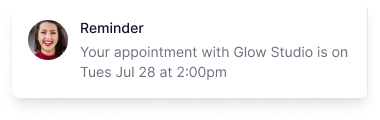
The highest-leverage fix is a two-message sequence: one 2–3 days before the appointment, one the morning of (or evening before for early slots).
Why it works: Clients book color three weeks out and forget. Reminders reactivate intent and give honest cancellers time to reschedule — better than a silent empty chair.
What to include:
- Date, time, stylist name
- Service name (e.g. “Partial highlights — 2 hr”)
- Address or map link
- One-tap reschedule or cancel link
- Cancellation policy (especially for long color blocks)
Channel: Email for detail; SMS for the day-before nudge (higher open rates). See DaySpark vs Fresha for how different platforms handle SMS pricing.
ROI example: 13 no-shows/month at $95 average; rate drops from 11% to 7% → ~5 recovered appointments/month = $475/month, $5,700/year.
Intervention 2: Deposits on long appointments
Require a deposit — typically $25–$50 for cuts, $50–$100 or 25–30% of service price for color and extensions — at booking.
Why it works: A deposit signals the block has real value. Clients who won’t commit self-select out at booking instead of ghosting a 2-hour chair.
Salon-specific notes:
- Apply deposits to services over a time threshold (e.g. 90+ minutes) or dollar threshold (e.g. $100+)
- State policy on the booking page, not only in confirmation email
- Collect automatically through booking software — front desk shouldn’t chase cards for every color client
Full policy guidance: how to require appointment deposits.
ROI example: Add $40 deposit on color services over $120. No-show rate on those services drops from 14% to 6% → 6 recovered appointments/month at $140 average = $840/month, $10,080/year.
Intervention 3: Card on file (without upfront charge)
If deposits feel too aggressive for your brand, card on file at booking still reduces casual no-shows. Clients know a late-cancel policy can be enforced; serious clients don’t mind.
Why it works: Similar psychology to deposits with lower booking friction. Also speeds checkout when charging the balance at the chair.
Intervention 4: Confirmation in reminders
Add “Confirm your appointment” with a link or reply — surfaces cancellations early enough to offer the slot to waitlist clients or walk-in color corrections.
Salon value: Filling a color block from your waitlist the day before beats an empty chair at 10 a.m.
Intervention 5: Waitlist and short-notice outreach
When someone cancels via your reminder link, message 3–5 clients who asked for sooner appointments. Even a simple text — “A Tuesday 2 p.m. color slot opened — want it?” — recovers revenue.
Implementation order
- Week 1: Two-step automated reminders (email + SMS if on Growth plan).
- Week 2: Deposits or card-on-file for color and long services; update booking page copy.
- Week 3: Add confirm/reschedule links to reminder templates.
- Week 4: Short-notice waitlist process for cancellations.
Combined ROI model
| Metric | Before | After |
|---|---|---|
| Monthly appointments | 280 | 280 |
| No-show rate | 10% | 4% |
| No-shows per month | 28 | 11 |
| Recovered appointments | — | 17 |
| Average value | $110 | $110 |
| Monthly revenue recovered | — | $1,870 |
| Annual revenue recovered | — | $22,440 |
Salon software that automates reminders and deposits typically costs less than one recovered color appointment per month.
Tools that make this automatic
Manual reminders don’t scale across eight stylists and weekend volume. The right platform runs email sequences, collects deposits at booking, and sends confirmation links without front-desk chasing.
DaySpark includes email reminders on all plans, deposits and card-on-file on all plans, and client notes for formulas and preferences. SMS reminders are on Growth and Professional ($99/mo+), with SMS requiring a $5/mo add-on (US and Canada). Compare options in our hair salon software buyer’s checklist.
DaySpark offers a 14-day free trial with no credit card required — configure reminders and deposit rules once, then let them run every week.