


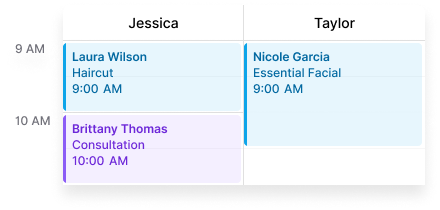
Scheduling is the operational core of any med spa. When it works, your providers are fully booked and clients show up on time. When it doesn’t, you’re double-booked, fielding calls about slot availability, or staring at calendar gaps that should have been filled. The scheduling software you choose determines which of those experiences is your daily reality.
This guide focuses specifically on scheduling capability — real-time availability, multi-provider management, resource booking, and how well the software handles the complexity that med spas actually deal with.
What makes med spa scheduling different
Med spas are more operationally complex than a hair salon or yoga studio in a few specific ways:
- Multiple providers with different certifications — not all providers can perform all services
- Resource dependencies — some treatments require specific rooms or equipment, not just a provider
- Variable appointment durations — a laser treatment takes very different time than a quick injectable appointment
- High-value bookings — a scheduling mistake at a med spa often means a lost $200+ appointment
- Client preparation requirements — some treatments require pre-visit intake, consent, or instructions that need to be collected and confirmed in advance
Good scheduling software handles all of this without requiring manual workarounds.
1. DaySpark

DaySpark’s scheduling engine is built around real-time availability across a full team. Services are configured with duration, assigned providers, and any custom availability rules, so clients only ever see slots that are actually open.
Scheduling-specific strengths:
- Provider-specific service assignment — clients can choose a specific provider or be flexible
- Real-time calendar sync across all team members
- Digital intake and consent form collection tied to appointment confirmation (Growth plan and above), so forms arrive before the visit
- Deposit and card-on-file collected at booking on all plans, which reduces no-shows without manual follow-up
- Automated email reminders on all plans; SMS reminders available on Growth and Professional plans (separate $5/mo SMS add-on required, US and Canada)
Best for: Med spas with 1–10 providers that want scheduling, intake, payments, and reminders in a single platform. The Essential plan ($59/mo) covers small teams; the Growth plan ($99/mo) adds intake forms, SMS reminders, multi-location, and up to 10 staff per location.
2. Boulevard
Boulevard’s smart scheduling engine is one of its differentiating features. It looks at the full schedule when inserting a new appointment and can suggest slots that minimize gaps and maximize provider utilization — valuable for high-volume practices.
Scheduling-specific strengths:
- Intelligent slot suggestion to reduce dead time between appointments
- Strong multi-service and multi-provider booking support
- Service and provider-specific availability rules
- Client-facing booking with strong branding controls
Best for: Established, higher-volume med spas willing to pay for a premium scheduling experience and advanced utilization optimization.
Limitation: Entry cost is high ($175–$400/month) and some scheduling features are gated to higher plans.
3. Vagaro
Vagaro offers solid multi-provider scheduling for practices that want marketplace exposure alongside their own booking page. Providers have individual calendars and availability, and services can be assigned to specific staff.
Scheduling-specific strengths:
- Multi-staff calendar with color-coding
- Service-to-provider assignment
- Both marketplace and direct booking links
- Class/group scheduling alongside individual appointments
Best for: Practices that want to leverage the Vagaro consumer marketplace as a discovery channel alongside internal scheduling.
Limitation: The interface is dense. Getting a clean, branded booking experience requires more configuration than some competitors. Key features like forms require paid add-ons.
4. Jane App
Jane has one of the cleanest provider-centric scheduling interfaces in the healthcare-adjacent software category. Each practitioner has a clear daily and weekly view, and the booking system handles complex provider rules well.
Scheduling-specific strengths:
- Multi-practitioner scheduling with individual availability profiles
- Resource and room booking (not just provider)
- Waitlist management
- Strong self-booking flow with clear confirmation steps
Best for: Med spas with clinical or health-professional orientation that also need charting or insurance billing alongside scheduling.
Limitation: The client-facing booking experience is more clinical than lifestyle-oriented, which may not match the brand feel of a high-end med spa.
5. Fresha

Fresha’s booking flow is fast and clean, and the calendar interface is easy to navigate even for teams less comfortable with scheduling software. The no-monthly-fee model lowers the barrier to entry.
Scheduling-specific strengths:
- Simple multi-staff calendar
- Consumer-facing booking page included
- Clean mobile experience for clients
- No monthly subscription
Best for: Small teams or solo operators that want a consumer marketplace alongside a clean scheduling tool.
Limitation: The commission on new client bookings adds up quickly on high-ticket services. Resource/room booking is limited. Not designed for complex scheduling logic.
6. Mindbody
Mindbody handles both appointment-based and class-based scheduling, which makes it flexible for practices that offer both. The calendar is functional and supports multi-location scheduling.
Scheduling-specific strengths:
- Appointment and class/group scheduling in one platform
- Multi-location support
- Staff management and payroll tie-in
- Consumer marketplace similar to Vagaro
Best for: Larger wellness and med spa businesses that run both classes and appointments, especially those already on the Mindbody platform.
Limitation: Interface complexity and cost are significant obstacles. Smaller teams often find it overkill and under-intuitive.
Scheduling feature comparison
| Platform | Multi-provider | Resource/room booking | Intake forms at booking | Deposits at booking | Starting price |
|---|---|---|---|---|---|
| DaySpark | Yes | Yes | Growth+ plan | Yes | $59/mo includes 3 staff on Essential plan |
| Boulevard | Yes | Yes | Yes | Yes | ~$175+ |
| Vagaro | Yes | Limited | Add-on | Yes | ~$30/mo + $10/staff/mo |
| Jane App | Yes | Yes | Yes | Yes | ~$54/mo, limited to 1 practitioner and up to 20 appointments/mo |
| Fresha | Yes | Limited | Limited | Yes | ~$15/staff/mo + 20% commission on bookings |
| Mindbody | Yes | Limited | Limited | Yes | ~$139/mo + add-ons |
Scheduling software for your practice size
Solo or 1–2 providers: DaySpark Essential ($59/mo). Simple setup, clean client experience, everything you need without paying for a team-size platform.
3–8 providers, growing practice: DaySpark Growth ($99/mo) or Jane App. Intake forms, SMS reminders, access controls, and multi-location support at a price that makes sense for a growing team.
8+ providers, high volume: Boulevard or Mindbody. The advanced utilization features justify the cost at scale, and both handle multi-location well.
Scheduling software is one of the few tools you’ll interact with every single hour of your working day. It’s worth running a real trial with your actual team, services, and booking scenarios before committing.
Further reading: Best med spa software in 2026 · DaySpark vs Mindbody · DaySpark vs Boulevard · Med spa no-show playbook · Add online booking to your website